 Share
Share



The Creative Crafts Center at Man Gardens is an inspiring place in Thailand’s Sakon Nakhon district. Its owner is Prach ‘Mann’ Niyomkar, an indigo textile artist from Sakon Nakhon who works with local weaving ‘aunties’ to both produce indigo and the naturally coloured textiles. His brand, Mann Crafts, is one of the region’s leading textile brands. Niyomkar’s nickname means ‘yes’ in the Issan language while Man Gardens’ name means ‘mankind’ or ‘humanity’ in the language, which he wanted Man Gardens to symbolise.
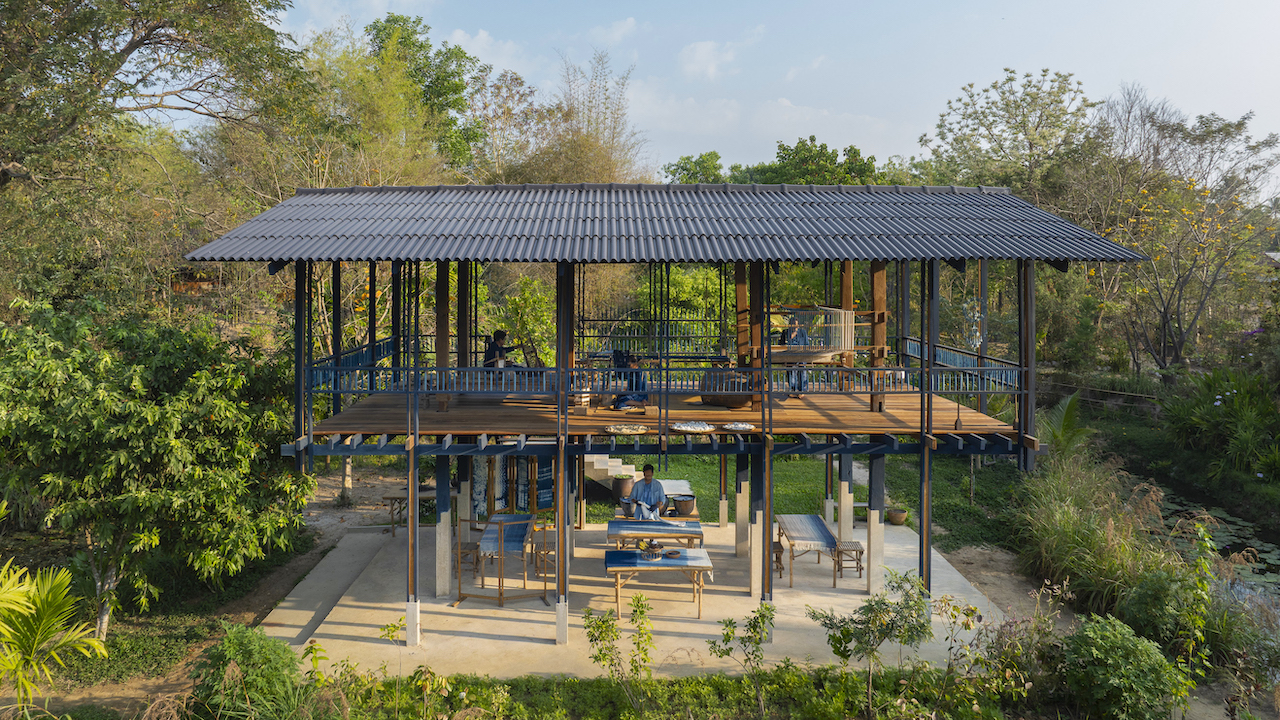 Indigo Loom House is supported by the Office of Contemporary Art and Culture, Ministry of Culture and INDA (a project resulting from Chuenrudeepol’s on-going investigation into the structural consistencies in the micro and macro scales of objects and architecture).
“It is a cultural hub for the Sakon Nakhon community, as well as out-of-towners, to come together to celebrate nature, craft, music and art. He wants it to be a public gathering space where Sakon Nakhon culture is learned, taught, disseminated and celebrated,” explains Chatpong Chuenrudeemol, who elaborates that it is Niyomkar’s “open-air forest laboratory” where the owner grows different species of rice, plants and fruits that go into producing the natural colours to dye his fabrics.
Chuenrudeemol is a Thai architect and founder of Bangkok-based Chat Architects who was engaged to design Indigo Loom House, a new facility within Man Gardens. “Khun Mann experiments with natural colours, dyeing not only textiles, but also wood, leather, paper and even stones. He wants to support the growing art culture in Sakon Nakhon, and invites artists and the general public to Mann Gardens to appreciate nature and art through workshops,” Chuenrudeemol elaborates.
Khun Mann prices these workshops affordably; a meal is also included in the price. This is an important gesture, as Sakon Nakhon, in Thailand’s northeastern Issan Province remains one of the country’s poorest rice-growing region. Chuenrudeemol stresses on the importance of Man Gardens to the community. The facility also houses the Mann Crafts Store, which sells the brand’s textiles and clothing.
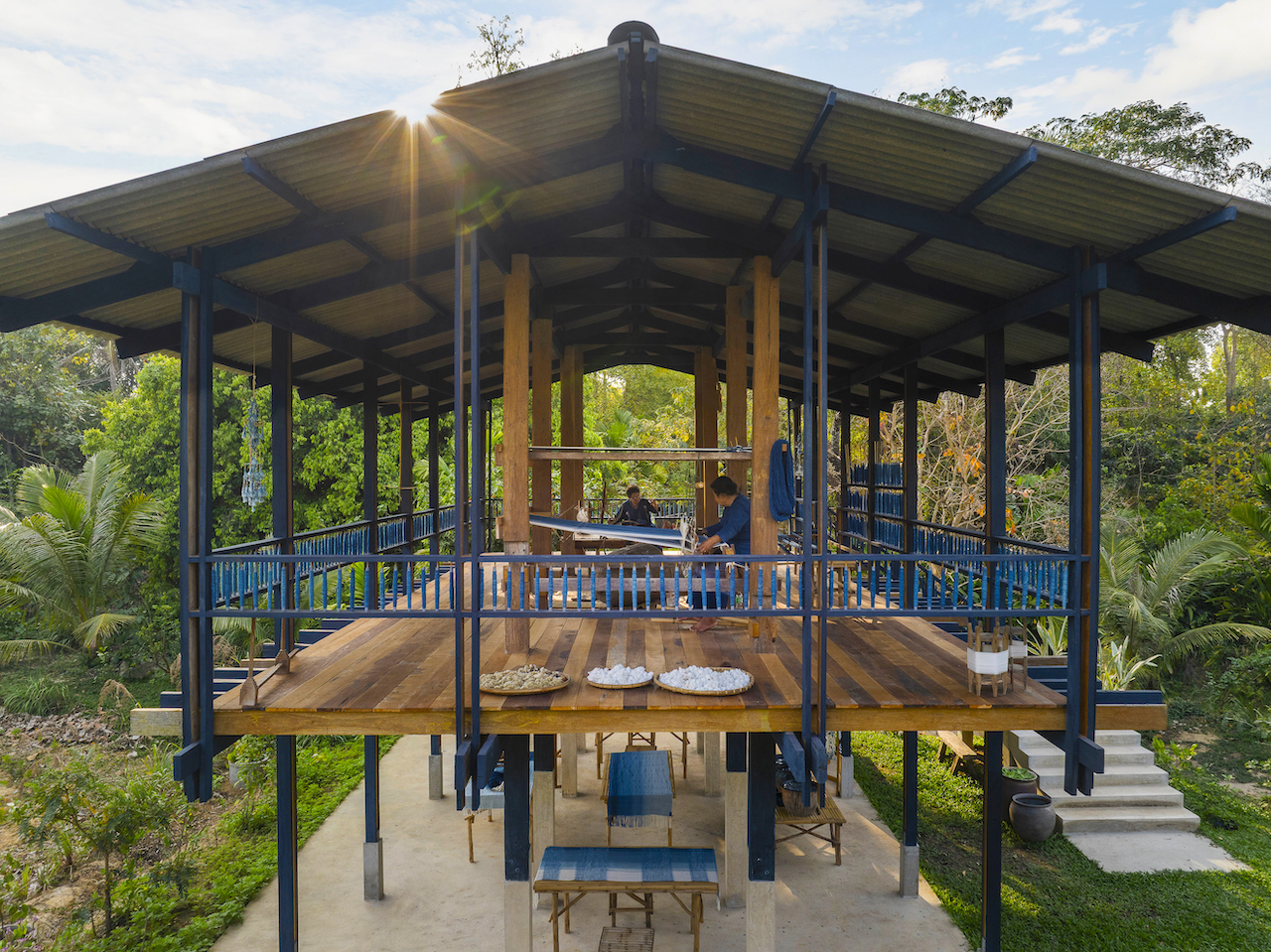
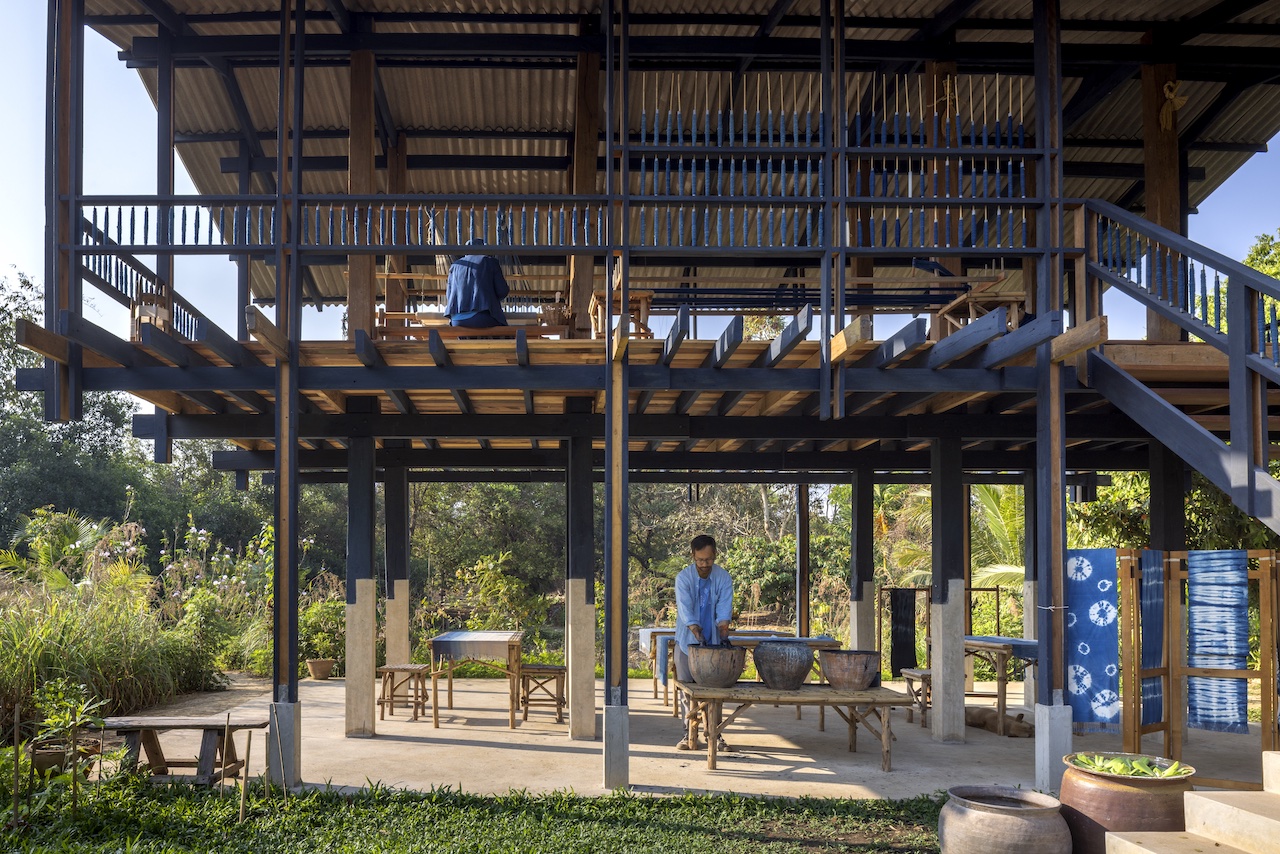
The Indigo Loom House is a pavilion-like timber structure with a pitched roof that advertises its programming through its architecture, such as by dyeing parts of the structure with beautiful indigo paint. “The Indigo Loom House is a ‘bastard’ or crossbreed between the typical Thai wooden house-on-stilts and the textile loom,” explains Chuenrudeemol.
‘Bastard Architecture’ is a framework he developed starting in 2017. It discourses on the value in ‘crossbreeding’ everyday, peripheral spaces and structures to conceive original and localised creations. Rather than grand ideologies, Chuenrudeemol studies the creative solutions of the everyday man on the street – makeshift carts, temporary dormitories of construction workers, outdoor movie theatres – that are overlooked by theorists and usually deemed as ‘eyesores’.
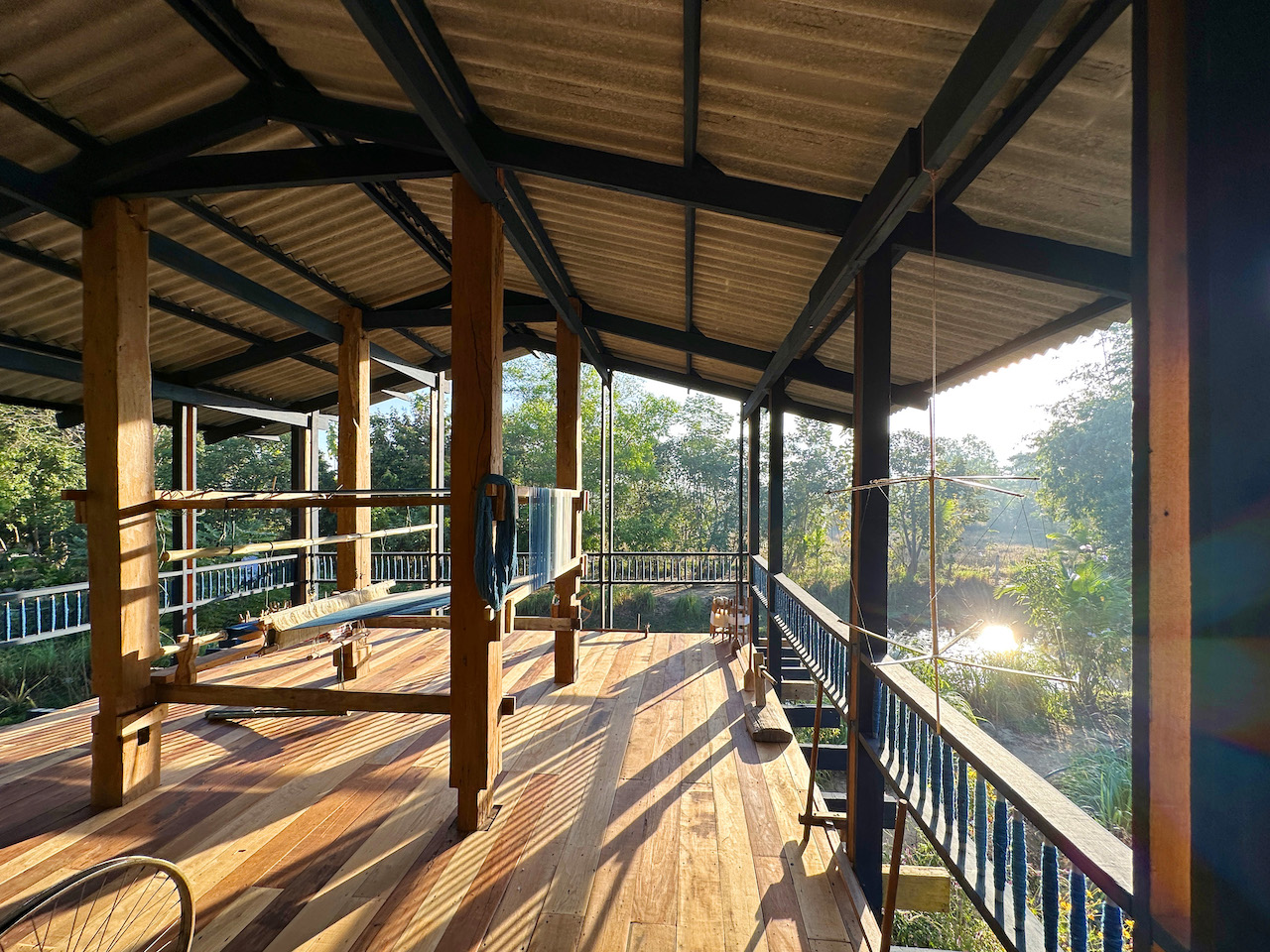
For Indigo Loom House, alignment between idea and iteration is expressed through the evolution of the ‘Condo-Kee’ (The Loom Condo), which was inspired by local vernacular architecture. The structure’s modularity – and likewise, that of the loom – is broken down into a series of stackable parts supporting multifarious functions, including weaving activities for elderly women, educational activities, and communal activities.
 Sakon Nakhon is an area in the Issan region gaining interest for its handicraft traditions, such as natural textile dyes derived from plants and bark.
The space also encourages local housewives and other interested parties congregating to exchange knowledge and titbits on life.
“It is interesting that the loom itself “can be seen as a little ‘house’ or micro-architecture that has four wooden legs. This house/loom hybridity is reflected in the house’s structural grid – two clusters of four salvaged, wooden columns that are the main structural supports for the building. The dimensional spacing of each four-column cluster is the same as that of the spacing of the legs of a textile loom,” says Chuenrudeemol.
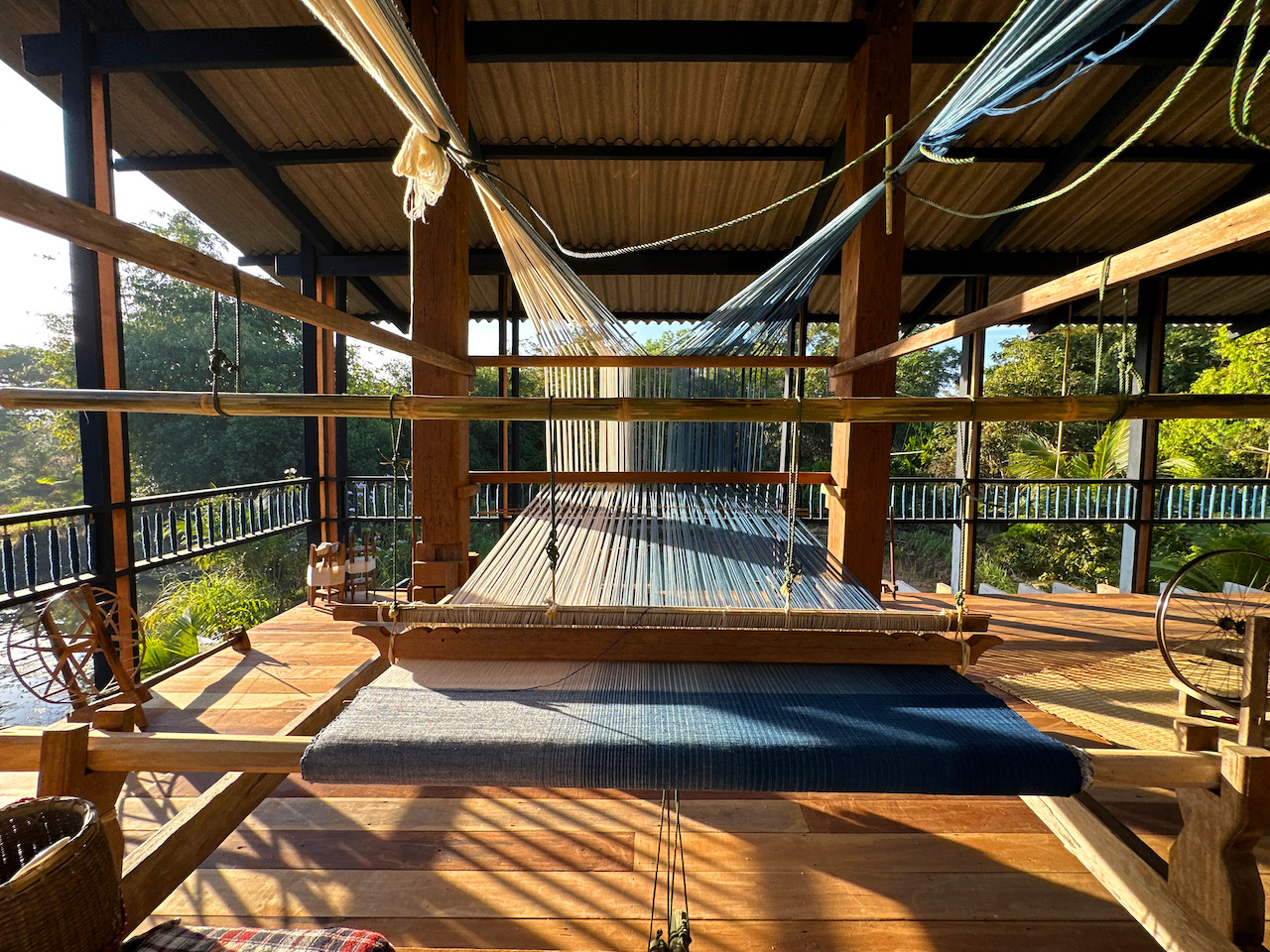
He expounds, “As such, old loom components can be retrofitted onto the four columns on the second floor. Therefore, the textile loom metaphorically and literally (by means of its structure) supports the Indigo Loom House. We are trying to emphasise the importance of the inextricable link to rice, farming and family (as symbolised by home) in the Issan Province.”
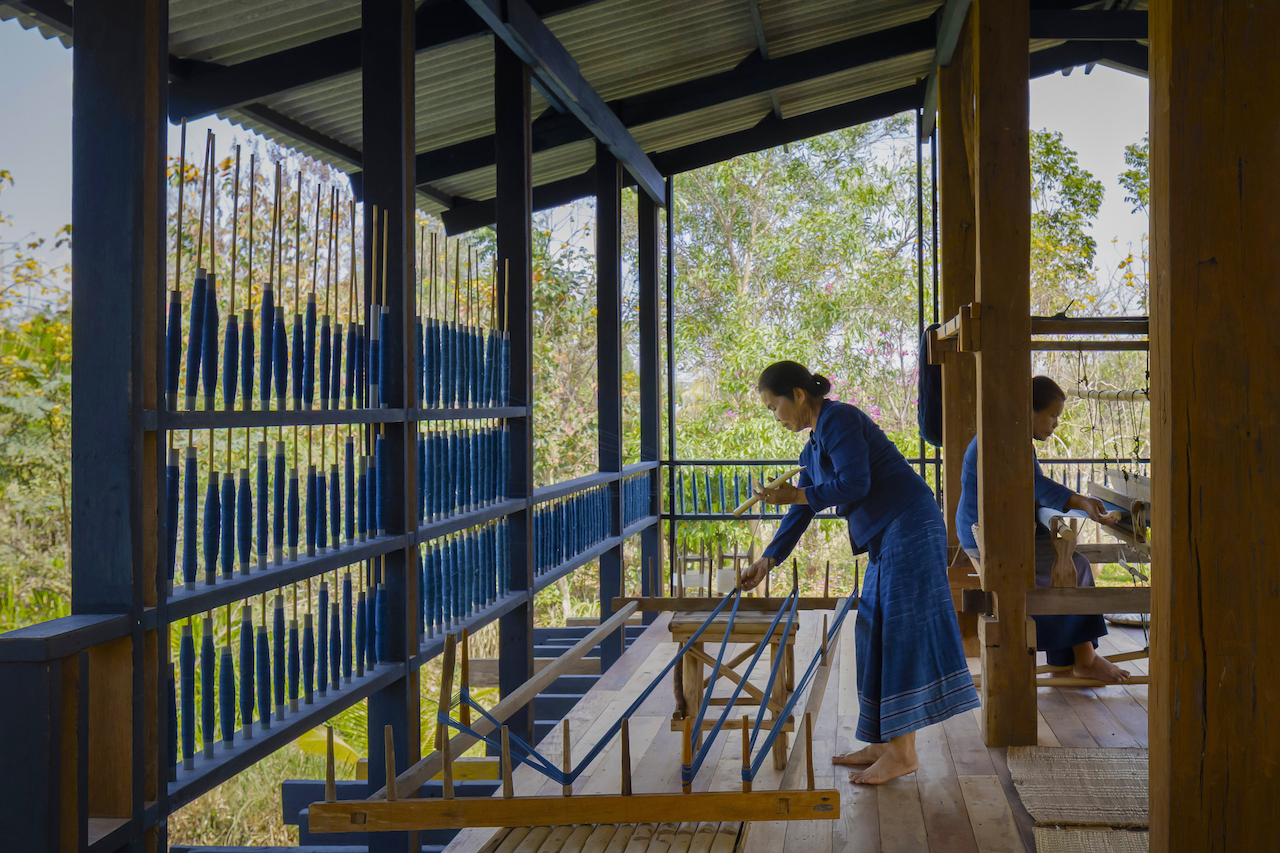 The project incorporates the wooden components from looms, warping boards and spindle wheel.
Similar to the weaving process, Indigo Loom House was a result of improvisation – a process that helps create a high-quality product as refinements are made along the way. “For example, the vertical handrail [elements] become ‘housing’ for the thread spools, thus providing yarn storage and display, as well as guardrail safety,” Chuenrudeemol points out. In this way, the building does not just reference vernacular Thai architecture through its pitched roof, extended roof eaves and elevated structure expressed like a sort of skeletal diagram of its precedent; it also references vernacular craft.

Chuenrudeemol mentions, “The sizing of weaving looms, warping frames, threaded spools and spinning wheels all determine the proportions of the architecture, just as much as the proportions of the columns and beams [that were taken from] a salvaged house.”
The project is inspirational also through the multi-faceted collaborative process. Chuenrudeemol came up with the architectural design together with students from Indigo Loom Studio, which is a community design studio course within the International Program in Design and Architecture (INDA), Faculty of Architecture, Chulalongkorn University.
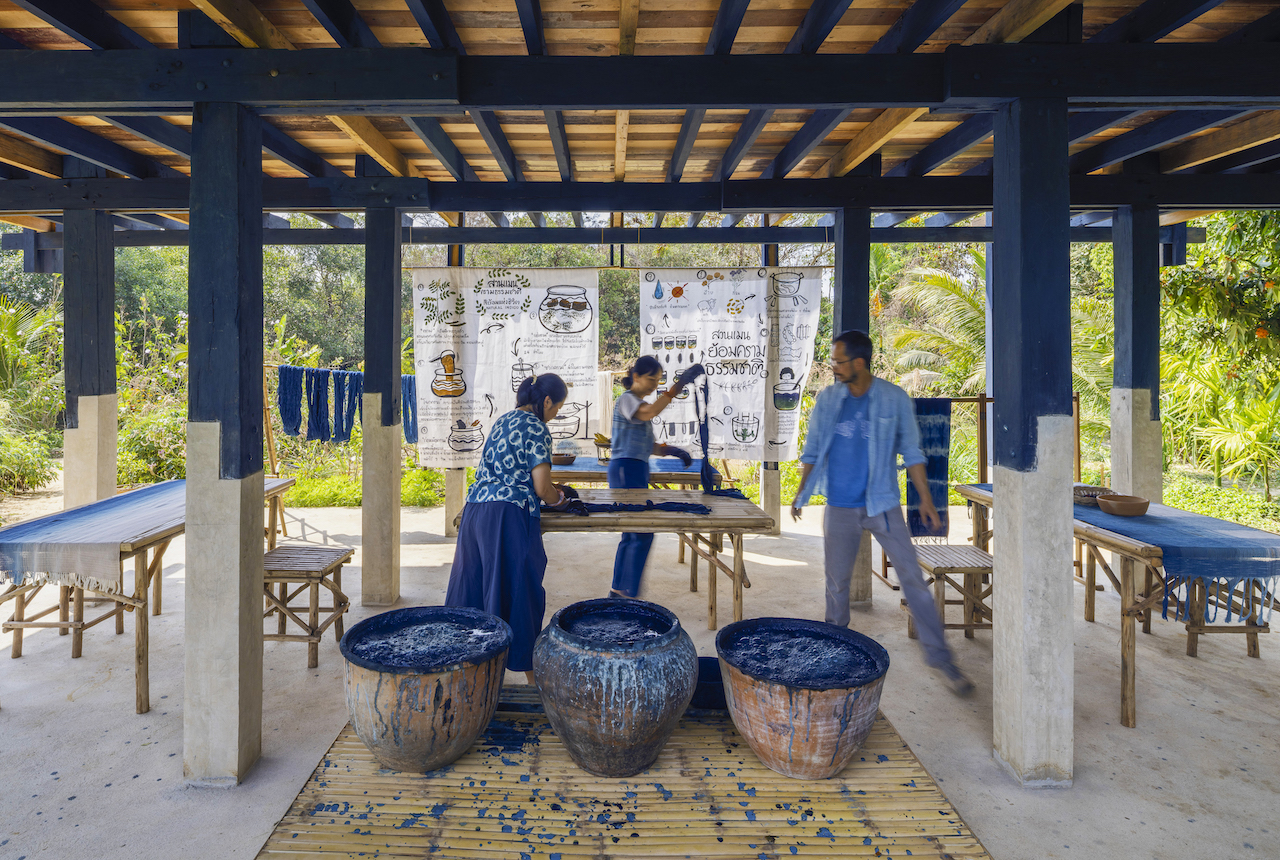
As the indigo used to dye textiles could not be directly applied to the timber, Niyomkar developed a new indigo formula for the job, drawing from traditional painting techniques that incorporate durable, vibrant and high-quality pigments. Chuenrudeemol shares that the same craftsmen making the looms in Sakon Nakhon build the Thai houses there. This too, gives poignancy to the narrative.